Monica Froese [00:00:01]:
Welcome to the Empowered Business Podcast, where strategy meets action. I’m Monica Froze and I’m here to help you create, sell and scale digital products the smart way, using AI and proven strategies to build a sustainable, profitable business. If you’re ready to turn your expertise into digital products that sell and eventually grow into a thriving digital shop, you’re
Monica Froese [00:00:22]:
In the right place.
Monica Froese [00:00:23]:
Each week I break down real world tactics, unfiltered insights, and bold business moves. Because building a digital product business should be sustainable, scalable and designed for long term success. Let’s ditch the fluff, leverage AI to work smarter and turn your expertise into a thriving digital empire on your terms. Let’s get started. Welcome back to the Empowered Business Podcast.
Monica Froese [00:00:49]:
Today I’m doing something a little different. I’m bringing you behind the scenes into a peer mastermind that I’m a part of, where we had an unfiltered, high level roundtable all about recurring revenue. This wasn’t a scripted interview or a formal presentation. It was a candid conversation between business owners who are in the trenches talking about what’s working, what’s not, and the real strategies that we’re using to build consistent income in our businesses. You’ll hear fresh perspectives, practical ideas, and maybe even a few aha moments you can take and run with in your own business. I’m joined by my friends Destini Kopp, Sage Grayson, Kate Kordsmeier, Faith Mariah, Liz Stapleton, and Ruth Pound White. Let’s go behind the scenes and dive into the recurring revenue roundtable.
Destini Copp [00:01:38]:
All right, I think I am the host for today. We’ll probably hear some more beeps coming in as everybody joins us. I want to thank everybody for taking time out of your busy schedule for our roundtable discussion. Today is actually one of my favorites. We’re going to be talking about recurring revenue. We’ve got some really good questions coming in from the Airtable forum that we’re going to be talking about today, but we will give priority to those who are here live with us. So if you have questions for any of us, you can start putting them in the chat and I’m going to be leading it. I’m going to be monitoring the chat while everybody is answering all of our questions here.
Destini Copp [00:02:20]:
Well, I think what I would like to do first is to give the panelists a chance to very quickly introduce yourself. Sage, you are right there on my screen. You’re the next person, so why don’t you begin there.
Sage Grayson [00:02:32]:
Hey there. I’m Sage Grayson and you can find me at Sage Grayson.
Sage Grayson [00:02:37]:
Com.
Sage Grayson [00:02:37]:
I’M so excited to be here to talk about recurring revenue with you. I have been coaching for, gosh, more.
Sage Grayson [00:02:43]:
Than 15 years now.
Sage Grayson [00:02:45]:
I’m a former book editor turned life and business coach and I like to call my followers the Life Editors. So if you like tiny little edits and tiny little tweaks, you will like my stuff. And I’ve got lots of great tips for you for getting recurring revenue even with low priced memberships. So glad to be here.
Destini Copp [00:03:01]:
Thank you, Sage. Liz, you are next on my screen.
Liz Stapleton [00:03:04]:
I’m Liz Steepeson. I run ElizabethStepson.com where I teach you the legal side of running an online business. And I also run the annual Blogger Breakthrough Summit and a couple other summits under Blogger Breakthrough where we’re focused on streamlining so that you can earn more in less time. And I talk about recurring revenue not just from memberships, but also from low price payment plans and how those can add to your recurring revenue line too.
Destini Copp [00:03:25]:
Thank you, Liz. Faith, you’re next on my screen.
Faith Mariah [00:03:28]:
Sure. I’m Faith Mariah. I do a combination of mindset and simple business strategy to help people build to six figures. Right now I’m really obsessed with events, so if you go to faith MariaVets.com, we’re always recruiting for something.
Destini Copp [00:03:43]:
Monica, hello.
Monica Froese [00:03:45]:
I run two brands, an empowered Business and the Empowered Shop. And I teach content creators how to create digital products and then eventually open a digital product shop. Once you have enough digital products, you need a central place to send people. So that’s what I teach. And I have a different type of membership mindset, support membership. So it overlays everything on business which is a little bit of a different structure. So I’m happy to talk about that today.
Destini Copp [00:04:12]:
Ruth, you’re next.
Ruth Poundwhite [00:04:14]:
Hi everyone.
Ruth Poundwhite [00:04:15]:
I’m really happy to be here with my lovely mastermind. I am a business and self belief coach. I have a couple of memberships at the moment that I have been running for about two years. I’ve been, I have had memberships since way, way back. I’ve gone back and forth between lower ticket, higher ticket, all of the things. But what I do right now is the soulful sales society. So yeah, really excited for this conversation.
Destini Copp [00:04:47]:
Kate, you’re next.
Kate Kordsmeier [00:04:49]:
Hey everybody. I’m Kate Kordmeier and I have been calling myself an accidental membership owner. I now have four memberships. I don’t know how it happened but once it did I was like, wow, recurring revenue is the best. Why didn’t I think of this sooner? So I’m excited to Chat today about all things membership, recurring revenue, subscription models.
Destini Copp [00:05:15]:
Yeah. So everybody on here has tons of experience with recurring revenue. I’m your host, Dr. Destini Kopp, and super excited to be here. I actually have four memberships that I run also two in my personal brand and two in my B2C brand. Super excited to jump into this topic. Like I said, if you have questions and you’re here live, we’re going to give priority to your questions. But I’m going to go ahead and kick it off because we did get some questions that came through.
Destini Copp [00:05:42]:
We got a lot of questions, I should say, that came through, and I’m going to pick one of them. We’re going to get started and then I’ll start looking at your questions. And I think this one, I really love this one, it came in and the question is selling membership seems to be very much tied to numbers, meaning having a large audience enough to sell to. So how do you even start if you have a small audience and you’re just trying to get started?
Faith Mariah [00:06:11]:
I think it depends on the price point, right? Because you could have a membership that’s $10,000 a month and you don’t need that volume. So any low ticket offer, whether it’s a reoccurring or a one off, you’re going to need more volume to make the same amount of money. And so what I like to tell people to do if they want to have a lower ticket membership, is to sketch out what kind of outcome you want to get for people in that membership and then either make workshops related to that that we can sell while you’re building your list and then we can eventually put those workshops into the membership. So you’re building out your portal and having things to sell and we’re building your list. And once you get the volume there, then we can launch that membership. So that’s one thing I tell people to do, that have a small list.
Destini Copp [00:06:58]:
Anyone else want to jump in there?
Ruth Poundwhite [00:07:00]:
I’ll jump in. So it really, it depends on your market as well. I used to have a few memberships. Then I did not have a large audience whatsoever. Now, I know this was a long time ago and things change and all of this, but I think the principle still remains. So, number one, I had a really good, like, very targeted niche. It was different to what I do now. So it does depend what you do depending on.
Ruth Poundwhite [00:07:22]:
Secondly, I had a lot of success with a community of affiliates and we would promote each other’s stuff. And actually that really got the ball rolling for me. Again, it Depends like who you know and what your niche is. But I just wanted to put it out there that there are different ways of growing than just your own audience. There’s also ads and people have loads of success with lower ticket memberships. Evelyn Weiss is someone that a lot of us look up to as a membership owner. She has like a lower ticket membership, she runs ads to it and then upgrades people to like a higher tier. So there’s like loads of different ways to do it that don’t all rely on your preexisting audience and it can actually grow your audience as you go.
Liz Stapleton [00:08:05]:
Yeah, I was going to say collaboration.
Ruth Poundwhite [00:08:07]:
Right.
Liz Stapleton [00:08:08]:
Whether it’s with affiliates, whether it’s just with other people in your niche that are offering different offers. Right. But it’s complimentary. One of the best ways I sold my worship was off the back end of a summit I hosted. Right. And so I had lots of people promoting the summit. And obviously summits are a lot of work. I wouldn’t say start there, don’t start there, but do a freebie exchange, co host a workshop.
Liz Stapleton [00:08:28]:
You know, there’s lots of kind of less intense ways to collaborate with someone and be able to both grow your list and potentially sell your membership as well.
Kate Kordsmeier [00:08:39]:
I just will add one quick thing to that too, to say that you, you might have a small list now, but you don’t have to stay at a small list. And I find that a lot of people stay with a small list because they stay in creation mode and you keep trying to improve your membership and do all these things for the membership, but you don’t have anybody to actually sell it to and nobody knows you exist yet. So using a lot of these strategies that were just shared here, collaborations, affiliates, ads, there are so many ways to grow your list. And bundled summits, there’s. The options are endless. So I would say honestly, have a membership, have something to sell or have any offer to sell, but I would focus your time more on growing an audience before I would spend too much time tinkering with your offers.
Destini Copp [00:09:30]:
All right, I want to move into this next question here. And first of all, I think all those were some really good advice there. This one says, adopting a coaching business in the age of AI. Would you say a lower cost membership is a must have for coaches moving forward in why or why not? Would that be the case?
Destini Copp [00:09:55]:
This. Yeah, go ahead, Monica.
Monica Froese [00:09:57]:
Okay.
Monica Froese [00:09:57]:
Okay. Honestly, I feel like low ticket and high ticket memberships can work and it really does go back to your market and who you’re selling to and where they’re at in their business. Now my model is a little different and people laugh because I actually don’t care about retention, which is funny because I actually incentivize people to come and go as they please. And that is a very not common way of looking at it. But what happened for me was I have a lot of different ways you can work with me in my business. You can be in my self study courses and there’s two major ones and then I have 130 products in my shop and so I cover a variety of different topics and so I can’t be in 10 different places. That stretches me too thin. So I position my membership as come and go as you please.
Monica Froese [00:10:47]:
When you need support from me, when.
Monica Froese [00:10:48]:
You need support from my team, when you want to ask questions, when you want to get on Zoom like this with me, it’s $39 a month, cancel anytime. So I even tell people when they buy my courses, I’m like, if you’re not going to start for three months, you don’t have to get the support now. Come into the support group when you’re ready. And surprisingly, even though I don’t care about retention, it’s almost that not caring about it that keeps people around. I actually have very low churn. Even though I incentivize. I’m like, go ahead, leave when you want. But they stick around because I have very engaged calls if I can get people on Zoom with me.
Monica Froese [00:11:19]:
So this is, I think part of it is understanding your secret, like your secret power. And I know when I get people on Zoom with me, they love it, they love talking to me. So they stick around, they just don’t leave. And I tell them they can. So that’s how I approach it.
Ruth Poundwhite [00:11:33]:
Katie’s saying so many coaches telling me not to launch memberships, I keep putting it off. I would definitely like there are obviously pros and cons to all these different business models and sometimes maybe a course is better, one time thing, whatever. But I think that is there’s definitely no right or wrong and you don’t have to have one and you don’t, you shouldn’t, whatever the opposite of that is. I can’t formulate that sentence right now. But what I’m thinking is, so Sue’s in the chat has said the age of AI means you need to amp up the human in your membership, regardless of price point. I definitely agree with that. And just to let you all in on some of the conversations we’ve had behind the scenes in our mastermind we are often talking about the fact that and this goes for our low ticket memberships, you can have a membership with content that already exists. You don’t have to create anything new.
Ruth Poundwhite [00:12:24]:
And all we do is show up and do a live Q and A every month. Now that’s not the only way of running a membership. It’s one way of running a membership. But if you could think of it that way and think is there something I already have and can I just show up and connect with my people even just once a month in a Q and A. It’s a really low hanging fruit, like a really low hanging fruit offer. And this conversation comes up with a lot of us in the Mastermind and we. And when it is a very low ticket one that’s often the kind of price point that. So for example, I have a.
Ruth Poundwhite [00:12:55]:
One of my memberships is $7. There’s not a lot of stuff that will just sell without me doing offers on without me actually talking about it that much. But the $7 membership will. That’s one of the offers that will. And it feels like there are always times when we question like should I have this? Do I still want it? And then we’re like, hang on a minute. We’re getting to connect with our people by doing this recurring live session every month and the content in the membership is already done. It just feels like a. Like why wouldn’t you.
Ruth Poundwhite [00:13:24]:
Now obviously this is not true for absolutely everyone and I’m not saying you should. I don’t think that. I don’t believe in that. I don’t subscribe to that. But it is something to consider in terms of what’s your low hanging fruit version. And for me it’s a great way to get people in and then the opportunity there to connect with on that human level, which is definitely important in the age of AI through that kind of monthly support that I offer people.
Liz Stapleton [00:13:50]:
Someone in the comments just said I think there’s a lot of work in the back end of a membership and I think playoff of just what Ruth said. It really is up to you how much backend work there is. So a membership that I’m retiring is sitting around. People are still in. It is membership. Every year I run the summit. All the content goes in there and they have access as long as they pay. I’m putting work in once a year and I’m already putting that work in anyways, just hitting copy paste basically to get it inside the membership and so it’s really not a lot of work at all.
Liz Stapleton [00:14:18]:
For that membership. My other membership, which I just changed models on, is a monthly drop. There is some work, but it’s once a month as opposed to constantly having something show up every week or something. It’s up to you to design it in a way that meets the kind of level of work you’re willing to do.
Kate Kordsmeier [00:14:36]:
I’ll add to that too. I was going to say something really similar, Liz, that yes, it can be whatever you want and that I would encourage everyone to get creative with why something is a membership versus just a one off course or something. And like my $9 a month membership, this is the only membership I set out to create intentionally. And that one is, I think of it more as paid lead gen. It’s very similar to what Ruth said. We’re like, I literally haven’t promoted it since I launched it two years ago. We have over a hundred members in there and yes, people come and go, but I think the only work that it is for me is I host one call a month and that’s it. Like they have course content in the portal that does not change.
Kate Kordsmeier [00:15:21]:
It doesn’t get updated because it’s not like super something that would be out of date. Of course, if something was out of date, I would update it. It can truly look like whatever you want as long as the value is clear to somebody why they would continue to pay to stay in there versus paying once and you’re not having to deliver anything on an ongoing basis. And so some of the other memberships that I have accidentally come into have been more of my support style memberships where now I’m not actually teaching them anything, I’m just offering weekly calls. I have one membership called the Room that is literally just four calls a month, one call each week. And for a while that was all we did in it. It was just if you want group coaching, you want a community as a mastermind without the heavy price tag, this is a great place to do it. This is how you want access to me.
Kate Kordsmeier [00:16:12]:
This is where you come and get it. And you can be in any of my programs or none of my programs. And I’m just here to answer questions. And then I have some other ones that are just different formats of support. Like we have an email coaching membership where they get one on one email access. To me we have a voxer coaching membership. And so I don’t think of those quite like memberships but in the recurring revenue they’re subscription model type businesses or type offers rather. So I just get creative with what it could be it doesn’t have to look any certain way.
Sage Grayson [00:16:46]:
I just want to jump in. I know we got to go to another question too, but I love what everybody has been saying. I really agree with figuring out what you can do, what your capacity is for your membership too. And in addition to being aware of your energy levels, I also like to meet my clients where they’re at too. So I have an email membership where you get a one minute tip every week through email. There’s no live coaching to it and all of these are old blog posts or pulled directly from my courses. And at the end of every one minute email it says, PS this came from such and such course. So I’m getting digital product sales by people signing up and paying for that membership.
Sage Grayson [00:17:25]:
So that’s totally through email. There’s no live component to it. And then I’ve also got my weekly accountability calls where like Monica was saying, find out where you shine and do it. And when I get people on Zoom calls, they want to stay because that’s where I’m a really good coach. I’m my best. I’m my best coach yourself when I’m on Zoom. So I have the capacity to do both of those too. But like really look at what do you have time for? What resources do you already have? What can you pull from and put together with little effort.
Sage Grayson [00:17:54]:
I really like having those two memberships because when my calls are sometimes hard for people to show up to because I’m on the west coast. So I like having an email membership that if they can’t make it to a call, they can still get tips.
Monica Froese [00:18:03]:
Every week from me. One thing to that point too, I definitely shine when I am off the cuff. And I think I say the best things when I’m. When someone throws a question at me and I think about it in real time and I repurpose a lot of those calls into. I have a private podcast feed I’ll put it on. I actually just published one on my public podcast feed. Cause it was so great about my new email strategy and it was so off the cuff and a lot of good things came outta my brain. So I repurposed it into a podcast episode.
Monica Froese [00:18:30]:
So wherever you shine and people want to connect to you the most is a great way to start to think about what you wanna put in your membership.
Destini Copp [00:18:39]:
The other thing I wanted to touch upon, and I think, Kate, you might’ve mentioned it, or Ruth, I can’t remember, is the get it done weeks. And can you talk a little bit more about how you have Structured those and how your maybe your model or your membership has evolved and why you added them.
Kate Kordsmeier [00:18:58]:
Yes. So Get It Done weeks. I learned about this concept from Elizabeth Goddard, but I really made it my own and encourage everybody to do the same thing. Speaking of like age of AI and people wanting more human elements, I think they want things that like AI can’t hold, actually hold your hand through this. They can’t. There’s lots of things that can’t co work with you. It can’t give you that human element. So I decided I had been running Get It Done weeks as like standalone offers for about six months in 2024 and then I decided to move it inside my membership because my membership is like accountability.
Kate Kordsmeier [00:19:38]:
It is this community element. It’s coaching. And so it felt like this is a natural thing. Like people are coming here because they’re trying to get the like move forward and take action on what they’re learning and this is where we can do that. And so I’ve really created mine to be more like we pick one topic that we’re all going to work on together. I give them a checklist of what we’re going to go through and what they need to do. And then we have live calls for Q&As, for tech demos, for screen sharing, co working training during that week. They would give them prompts throughout the week of make sure you’ve done X, Y and Z from the checklist.
Kate Kordsmeier [00:20:15]:
And then there’s prizes at the end. So if you actually get it done, then you can win. We call it KK Credit so you can get credit. In our business, everybody who gets it done gets that. We give away things like free software tools. We also get you promoted on our email list and in our blog posts. So it’s free visibility for everybody who’s going through the Get It Done week. And I would say this has been one of the best things I’ve ever done for my business.
Destini Copp [00:20:41]:
It’s August, I think I’m hosting my 15th one and it has been so much fun. And I swear I never get better testimonials than I do from hosting Get It Done weeks because people are so excited that they were able to get so much done in one week. Like more than I’ve done in the last six months is the kind of things that I often hear. And it’s just such a win, win, win all around. Adding that to my membership also helped me improve retention and get new members coming in every month without having to do like a big launch. I basically just Send three to five emails the week before Get It Done Week saying, hey, we’re doing Get It Done Week next week. This is the topic, come join us in the membership. And we’ve gotten anywhere from 20 to 50 new members a month just from doing this strategy.
Ruth Poundwhite [00:21:30]:
I just want to add here, if you heard Kate reel off all the things included in Get It Done Week, mine are much simpler than that. I don’t do loads of live calls. I often will do like a kickoff call, but not necessarily. Sometimes it’s based on a training that’s already there. You’re just drawing people’s attention to it. And even if you are not doing the calls, even if you’re just sending one email at the start and one email reminding them in the deadline or doing that in a post or whatever, it motivates people. It really does motivate people. And I know that we’re going to talk about recurring revenue, not just memberships, but in the case of a membership where people are paying month to month, they are.
Ruth Poundwhite [00:22:11]:
I think this was something that I heard Evelyn Vice talk about and it’s really interesting way of thinking about it. It can be a bit scary, but it’s also powerful. People are making that decision every single month whether to keep paying you for your offer. And I think that one of the hardest parts of having a membership and also being in a membership is helping people actually use it in a way that is helpful to them. A lot of the time they don’t have to do the Get It Done week. There are other ways to make the most of it. But I think that putting it on the table is a very helpful way to get people engaging. Really important for that.
Ruth Poundwhite [00:22:46]:
And yeah, like Kate says, really great way of soft launching it regularly. And I think what we have found is sometimes when you have a membership it’s different to a standalone course and sometimes you feel like there’s more to talk about. So then when you launch it, you feel like you’re watering it down a bit because you’re trying to talk about all the things when you’re promoting it from the perspective of I ever Get It Done week starting next week, you launch it based on that thing. The content is based on that topic and I think it really narrows it down in a very powerful way for the messaging. I’ve certainly found that really helpful in that clarity of how you’re talking about your membership as well as giving people a time sensitive reason to join as well.
Kate Kordsmeier [00:23:26]:
Destini, you should share about how you have created your own version of this with a live workshop model that’s a little different than get it Done week, but quite similar in a lot of ways too.
Destini Copp [00:23:36]:
Yeah, it really is similar. So we do the live workshop and I do promote it. You can come to this live workshop or you can get it for free, or you can get it for free inside of the membership or you can pay for it separately generally not every single month. And then we get it done in that live workshop so we actually have a working session there. I have been inspired though I’m doing things a little bit differently in August where in some of the workshops that I’m doing, I’m giving them prizes for actually getting it done. So they’re submitting their work and I’m going to be review it and they get it done. They get a surprise prize for doing that. So I do think that’s an incentive for people to actually get the work done.
Destini Copp [00:24:18]:
But the reason why I love this model is exactly what you said, Ruth. It gives me something to talk about, not only in my newsletter, in my emails, in my podcast, so I can highlight that content every week. So it’s like fresh content that I am giving to my audience. And sage, you do them too, right?
Sage Grayson [00:24:41]:
Yeah, mine’s very similar to what others have said too. What I like to do is give a free course that goes along with whatever topic or project we’re trying to get done that week so everyone can watch the course too and then come to me with their questions. We have a kickoff call, a co working call, a free course. And like Kate does, we do a five day checklist so everyone knows what.
Sage Grayson [00:25:01]:
To do each day.
Sage Grayson [00:25:03]:
And mine are not just business focused because I don’t have a niche. So we kind of do a little bit of everything. And one of my most popular get it Done weeks was manifest that money challenge. And in the week they manifested over a hundred thousand dollars, which I thought was pretty amazing. Granted, one person got a new job.
Sage Grayson [00:25:19]:
That was a big one, but I.
Sage Grayson [00:25:20]:
Think you can have fun with your get it Done weeks. It doesn’t always have to be like we’re going to make a new course or we’re going to do this like business thing. It could be about how to organize your to do list or how to set up a notion template or something that can help you with your business, but it also can help you with your life too.
Destini Copp [00:25:36]:
What I’d like to do is go back to the comment that we had and I want to explore recurring revenue beyond membership. So I’d love to hear your thoughts on that and some examples that you have in your business. Go ahead, Sage.
Sage Grayson [00:25:53]:
Oh, yeah.
Sage Grayson [00:25:53]:
So I have an everything offer, which is all of my digital courses, all of my past ones, and all my future ones in one big bundle. It’s called my Life Editor Academy. And before I would just sell it, like, I have one price of just one payment. Please give me my money and stop selling for a long time. And then I did a payment plan, and I’m so glad that I did, because they still legally have to pay all the payments. But I’m meeting them where they’re at, and I’m making it easy for them to pay it off and to digest the information. They don’t feel like I have to go through all of it because I just spend a million dollars on it. So I count payment plans as recurring revenue, too.
Sage Grayson [00:26:28]:
And I’m always adding new things in there, too. And I’m always asking them, like, what do you want to see next? What could I help you with? I have little things sprinkled throughout while they’re in the membership, asking them, like, oh, what course are you going to do next? Or how can I help you? So I think everyone who has, like, a really big offer, if it’s like a passive income thing, that might be the easiest thing that you can break into multiple payments and meet them where they’re at. Let them say, yes, do you want the sale or not? I wanted the sales. So I’m very grateful that I did break down my big offer into multiple payments.
Faith Mariah [00:27:00]:
I feel like I’m always the voice of. I’ve seen a lot of people burn out on memberships, especially beginner people. And it’s like this idea of, like, reoccurring revenue, like, it just comes into your bank account every month. But I think I really like the model, if you’re a beginner of building something like a course and then putting payment plans if you want reoccurring revenue, because you don’t have. Unless you’re like Monica and you don’t care about retention.
Faith Mariah [00:27:25]:
But if you do care about retention.
Faith Mariah [00:27:26]:
You have to market to the people that are already in there every month to stay. You have to market and go get new leads every month. You have to, like, market to grow your membership. And there’s just a lot of stuff that has to be done. I think it’s an awesome business model. I love my memberships. I’ve made a lot of money off of memberships, but I’m always like, there are different ways to do it. So I think if you’re man, I would like reoccurring revenue but I don’t know if I want to do ongoing support all the time.
Faith Mariah [00:27:54]:
Because the other thing is with memberships I think that burns people out is you have to do them like rain or shine. Like I’ve had to do them like after people have passed away and when I’m sick and all these different things in life and I think that’s fine. But I do think it’s something to consider. I think people don’t think about that when they start memberships because they’re like, oh, it’s going to be reoccurring revenue. And it’s yeah, you have to work every month. But I like if you’re like thinking about man, I would like to have reoccurring revenue but I don’t know that it’s sustainable for me to do a membership right now with everything going on in my life. I think the option they just talking about of doing the payment plans is a great way to do that. And we’ve done that in my business where we would sell different courses every month and I would do three month or six month payment plans and those payment plans stack up.
Faith Mariah [00:28:40]:
So then when you start the month you already have a couple thousand coming in before you’ve done sales and you’re not having the membership of having to show up and all that thing. And again, I show up in my membership all the time and I love it and I think it’s really great. But I do like to be that voice on the other side when we’re having these conversations. Just because I’ve seen so many people burn out.
Monica Froese [00:29:00]:
Devil’s advocate a little bit here. My MBA finance is going to come out on this one. So I have always very heavily incentivized pay in full when I launch, I heavily incentivize it because at the end of the day, the most administrative work I feel we have is failed payments when. And you can automate a lot of this, don’t get me wrong, but it’s not it. Those apps can get to be 15 deep when you think about all the different places they need to be stripped from in a membership or even a course. If someone’s failing on payments, you can’t have ongoing access to the content and then if you layer on private podcast feeds, it can get very robust your membership back end. So I’ve always been big on cash flow, like managing my cash flow. So if I have a launch and I heavily incentivize pay in full and I have a Big uptick in the business.
Monica Froese [00:29:48]:
I’m not turning around and just going to spend it because I got it. Because I think that the payment plans and recurring revenue give people a lot of business owners this level of comfort. But I listened to a podcast the other day where they were poo pooing on payment plans like big time and they were pretty much, no, give me the cash up front. I don’t want to have to chase you for your payment plans. And guess what? I just know how to manage my cash on the back end really well. I fall into that bucket more than anything. And it’s probably why I have such a chill attitude about retention in my membership. Just another way of looking at it too.
Liz Stapleton [00:30:19]:
And I totally agree with that because yeah, the back end and people failed payments, that’s definitely a thing. That’s a giant pain. That being said, I offered a low price payment plan on one of my summits and increased my sales by 30% like year over year. So you gotta figure out what you’re comfortable with, how much are you willing to chase people or if you’re just going to like let it go, discontinue access, I’m done. I have very few chargebacks like ever. Maybe a couple year effect. So, you know, it’s a matter of making sure you’re very upfront, setting expectations and going in and just making sure that you’ve automated all that you can because. And I actually do need to approve my failed payment follow up process.
Liz Stapleton [00:31:02]:
But overall, like, if I’m seeing that much of an increase, it’s worth it to at least occasionally offer payment plans. I’ve done that before too, where it’s like, hey, I’m bringing back the extended payment plan for something and I’ll see a bump in sales.
Destini Copp [00:31:15]:
I just wanted to say when I do my launch on my memberships or I have people coming in, my goal is to as much as I can get people on the annual plan. And my goal is 50% or more. I was told to shoot between 40 and 60%. It’s generally landed around 53% and that has definitely helped me out, no doubt about it. And I do what I do to encourage that is offer really juicy bonuses for that annual plan, but still have people coming in on the monthly. And that’s perfectly fine. That’s why I offer it, just to be able to serve them also. But annual plan is really what I shoot for there.
Monica Froese [00:31:54]:
I also saw a big entrepreneur in our space totally do away with stealth payment plans and move exclusively to if you want A payment plan you have to use Afterpay or Klarna which is very accessible to us now with Stripe. And while I don’t think I’m to the point where I’m going to do that, to Kate’s point in the comments, we are not a bank. And like I just did a I delivered a four hour workshop last week and I allowed a payment plan. I didn’t charge a premium price for it. The payment plan was equal to paying in full. And guess what, I got a failed payment for it today and that content was already delivered. So that’s the other thing. Now I have to go through and every workshop I don’t always set up the back end of failed payments, strip them out of things.
Monica Froese [00:32:33]:
So I had to send it to my VA and be like can you make sure they don’t have access to this now because the payment failed. So I believe in accessibility too. I try to make things accessible. But I think we can also think outside the box now with all these options popping up for why do we have to be the ones that finance it? As the business owner, why can’t it be like okay, you can use a third party system like Klarna or Afterpay. So that’s another thing to look at too because they get the benefit of the payment plan and as a business owner you’re getting the payment upfront.
Kate Kordsmeier [00:33:01]:
I’m so glad you said that Monica. I have experimented. I know this is maybe even now we’re going off on a tangent of payment plans rather than recurring revenue, but it is interesting because yeah, when I have had higher ticket items, I’m talking like $5,000 or more. I’ve often partnered with funding partners which is a little different than the payment plan like Afterpay or Klarna or what some of the other ones are. And a lot of my clients took that option, especially when I was posting like $10,000 mastermind I had the bulk of my people would use that and they would get much better interest rates and deals with funding partners. Now that I don’t sell High Ticket Elective is the name of a company that I use and for a while I hosted all of my payment plans through them because they handle follow up on failed payments for you and at no cost. And so it didn’t cost me anything more to offer that. But what I found was that a lot of my customers weren’t choosing that option because they have to fill out a form when they have to give their personal details and information.
Kate Kordsmeier [00:34:06]:
I think people are hesitant to do that. So now I literally have on my checkout which is probably pros and cons to this too. But you can pay in full and save 20%. You can do my in house payment plan which is a 20% premium on the price you can use afterpay Klarna affirm any of those choices. I have a link at the bottom that’s also we also offer funding through elective so people can choose that and I make sales with all of those different forms every single day. There’s people use all of the different options and this isn’t really about recurring revenue but it definitely is about payment plans and that there is a benefit to getting. Like Monica said, I get paid in full for those options. Now I have to pay a higher fee.
Kate Kordsmeier [00:34:55]:
I think you pay usually 5 to 10% to use those services versus you.
Monica Froese [00:35:02]:
Know, consider if the payment plans are failing and you can’t recover that.
Destini Copp [00:35:05]:
Exactly.
Kate Kordsmeier [00:35:06]:
It’s all a math.
Kate Kordsmeier [00:35:07]:
I think it all ends up out in the wash.
Ruth Poundwhite [00:35:11]:
I think these conversations super important. Like obviously we’ve gone on a payment plan tangent but super important when you’re considering recurring revenue. I just wanted to add one other thought and because we’ve talked about memberships we talked about like course payment plans. One thing that really changed things for me earlier on in this business when I did a lot of one to one coaching work was to charge what I actually wanted to charge which was a big deal because we’re talking about one to one. This is not a low ticket thing and getting clients in six month contract made a huge difference. So it’s not ongoing forever recurring revenue but it made a huge difference in stacking it. Like when I could would have different clients starting at different times stacking up those one to one payments made a huge difference. I just wanted to give that a little shout out because obviously everyone here has got a different business model and sometimes just the difference in bumping that price up a bit if you’ve been thinking about doing it, especially if it’s one to one, your time is precious and limited.
Ruth Poundwhite [00:36:13]:
Made a huge difference for me at that stage of my business.
Destini Copp [00:36:16]:
All right, any other comments on recurring revenue before we move on?
Kate Kordsmeier [00:36:22]:
I have a follow up question in the chat here from Suze that I just wanted to answer real quick. I use Kartra for my checkouts. Thrivecart also offers this. I feel like most people are probably with. I think everyone here is either with those two or Kajabi.
Kate Kordsmeier [00:36:37]:
I don’t.
Kate Kordsmeier [00:36:38]:
I think Kajabi offers sign out pay later Options now. But so this, most of this is all just done through my checkout software. So if you just go to a checkout page, I think if it’s like above a certain price, although I’m not actually even sure if there’s a like limit you have to hit, it will just give you the choice to say do you want to pay with these? So that’s it. I think that’s part of why it doesn’t feel overwhelming for people because it’s just like when you’re checking out, it’s sephora.com it asks you like split this into three payments of $33 and you’re like, I guess I could do that. And yeah, so I think that has really helped because it’s so integrated now versus and on my checkout pages I only offer payment plans for something that’s like over $500. I really haven’t offered payment plans for things that are like $70 or less than a hundred. I definitely wouldn’t offer a payment plan for. But to each their own.
Kate Kordsmeier [00:37:32]:
I’m sure that some people have and it’s worked well for them. So then I just have a checkout. You just choose pay in full or and it will say pay in full and save 20% and get these juicy bonuses or payment plan and you don’t get any of that but you get a more accessible payment option.
Faith Mariah [00:37:49]:
I was just going to throw in really quick. I’m like a little outlier I think in this, I don’t know realm but we’ve always offered interest free payment plans and I offer a lot of extended payment plans. I don’t feel like we have that many failed payments and we have a really good process for it. So I just feel like it doesn’t cost me that much and I love it. So I think sometimes, like sometimes you can make decisions in your business just because you think it’s cool. Like I think it’s dope. Like we offer interest free payment plans and no one else does. So if you think it’s you can like Monica, I want to like step on the mba.
Faith Mariah [00:38:28]:
But sometimes you could look at the numbers, right?
Faith Mariah [00:38:30]:
Look at the things.
Faith Mariah [00:38:31]:
But sometimes you could just do things in your business because you want to.
Monica Froese [00:38:34]:
Hey, you know that that’s totally fair. I blame my dad. He’s a CPA and he just has drilled this stuff into me.
Liz Stapleton [00:38:42]:
I do like industry. I maybe I do a couple bucks but like just like extra stripe fee, like I’ll do a couple bucks more on those. So it’s overall it’s maybe three or four dollars more than the full pay in full just because it then accounts for the like extra stripe fee I’m doing for the payments.
Faith Mariah [00:38:57]:
Do I eat some money on that? Probably? Sure. I just think like my excitement for it and the fun of it probably makes up for that. Maybe. I don’t know.
Monica Froese [00:39:07]:
Now I actually don’t charge a premium on my payment plans, oddly enough, even though.
Monica Froese [00:39:12]:
But I.
Monica Froese [00:39:12]:
But like Destini, I heavily incentivize paying full when I’m launching.
Faith Mariah [00:39:16]:
So do I. I’m always looking your bottom line. You guys know that because we talk about this every week. But I’m always like, what’s going to change the bottom line at the end of the year? I don’t really look at monthly, to be honest. I look at the last 12 months and that’s where my focus is now. When my business was starting, that wasn’t the case. Right. So there were months where I was like, I need cash, like to come in like this month.
Faith Mariah [00:39:41]:
And sometimes when that’s the case. Right. You might consider your that into your sales strategy a little different.
Destini Copp [00:39:49]:
All right. Speaking of doing things maybe a little bit out of the normal, I want to talk about the question that we have about Evergreen versus Open Closed cart on memberships. And I have very strong opinions on this. So I’m going to go ahead and just start and then we can have a discussion on it because there’s definitely different ways to do that. And I know that there’s some very high influencers in our industries that really teach the Open Close cartoon. I made a decision to basically to keep my memberships open because number one, it gives me that workshop and that content to talk about and promote every single month. And my thought process was there. People are just on different places in their business journey.
Destini Copp [00:40:33]:
At some point, something I’m going to be talking about is probably going to catch their eyes. And actually I’m okay if they come and go. I’m like Monica. Like I do in some sense that annual, even the lifetime pass. But if they, for whatever reason, if I can help them that month, I.
Destini Copp [00:40:52]:
Want to help them that month.
Destini Copp [00:40:54]:
So that’s the philosophy that I have taken.
Sage Grayson [00:40:57]:
Oh, I just want to quickly say I completely agree with that. When someone needs help, they need it now. So I want to be the one that’s available for them the moment that they need me. Yeah, both of my memberships, my email membership and my weekly accountability calls and progress party open all the time because I don’t know when someone’s going to need help. I don’t know when someone’s not going to be able to pay their rent and they need strategies now. And I just think, like meeting them where they’re at. I’m allowing them to say yes when they’re ready, whenever.
Liz Stapleton [00:41:27]:
I also just can’t be bothered to do no, that’s too much work.
Liz Stapleton [00:41:30]:
Like, I’m too lazy to do that.
Liz Stapleton [00:41:33]:
Like, I obviously do certain marketing pushes. I’ll launch something off the back end of a summit or something, but open all the time. Just because I initially, when I started my membership like four or five years ago now, whatever it was, open, close, I can’t be bothered. It’s too much work.
Ruth Poundwhite [00:41:50]:
What I want to add to this is I know that loads of you, like, even if your membership is open all the time, you’re doing things like the get it Done weeks, right? So there are reasons for people to join now that are not just it’s open now and it’s closed tomorrow. And one reason is I’m doing a Get it Done week and Destini say everyone is regularly doing things like Destini’s doing these workshops on a regular basis. You’re not just sitting back and having your membership there on your website and expecting people to join. Because I don’t think that is the way it works for most of us. Sadly, yes, if you’ve got like backend funnels, but also showing up and connecting with your audience and giving people a reason to join, even if it’s not that the doors are closing. I do think that’s really important element and everyone here is doing that. So just to be clear, and I do close my membership door, by the way, but I actually do think, especially since I’ve been doing these get it Done week promos monthly for I think I’m on like the fourth or fifth month now. I think that makes a bigger difference than me saying the doors are going to close.
Ruth Poundwhite [00:42:57]:
I think that me showing up and saying we have a get it done week starting and I’ve been offering a trial as well. We can talk about trials. That would be a whole other conversation as well. But I think that’s making a bigger difference than me just closing the doors. So it is important to think about what’s the reason beyond whether doors are open or closed that people would join.
Faith Mariah [00:43:16]:
Now I’ll say too, like, we do a launch model. So mine is not open all the time. And I love that. I’ve tried it Evergreen and for me, I hated it. I just. And it’s not because it’s I mean, anything can work, right? But I think it’s just kind of personally what feels better to you. To me, when it’s open all the time, it like feels like in the back of my brain I’m like, oh, I should be promoting it, I should be selling it all the time. Like that thought just lives back there and it leaks my energy all the time.
Faith Mariah [00:43:44]:
Whereas when I launch, it’s, I can focus, I can do sales, I can put all my energy on that, I can close it up and then I don’t have that, oh, I should be talking about it all the time kind of thing. And so that has worked really well for me, just like energy wise, I think, and the way my brain kind of functions. And I also love launching. So that model has just always worked really well for me.
Monica Froese [00:44:08]:
I obviously keep mine open because it’s meant to be a support membership. So I want you to come and go as you please. But the other thing is it allows me to have that as a call to action everywhere. So every, at the end of every podcast episode, I direct you to my membership if you want to get to know what it’s like to work with me. And it’s really low stakes. So that has helped me. The other thing is I used to. My business always operated on a live launch model and it does to a degree still because of cash injections are important.
Monica Froese [00:44:35]:
But what I used to do is I would close the doors and I stopped doing that. Instead, I usually incentivize during the launch period. It’s like you get extra bonuses and it’s usually some sort of price savings. And then when the doors close or when the cart, that cart open, period’s over, I keep the sales page open and I started implementing this thing where all the bonuses during the launch, they’re gone. What I do is I do with convert box, this box that pops up and it says you will only see this once for 30 minutes, which is true. And you can get it at the launch price. I capture after the closed cart period would have typically been over a lot of revenue that way because there’s still a lot of buzz about we just did this like concentrated launch window and I get a lot of sales that come in for weeks after because of it. Like people just got around to clicking through the email and they’re like, oh.
Monica Froese [00:45:24]:
Great, I can still get it at.
Monica Froese [00:45:25]:
This price point for 30 minutes. So that’s just another way that you can do something like that. Oh, and on my membership page, I don’t do it right now. Because we just switched payment processors. But we used to do the same concept where if you got on the page and it was the first time seeing it, you would save 10amonth if you sign up within that 30 minutes. That’s another way to do urgency while keeping the cart open.
Kate Kordsmeier [00:45:46]:
I’m just going to jump in here too to go back to the other question that we started with a few minutes ago about recurring revenue. And I just wanted to suggest a couple other ideas as well for people who are interested in recurring revenue, maybe in addition to or beyond memberships and or payment plans for one off products. And I think my answer is similar to what I said before about I am an accidental membership owner because I have all of these things that are now recurring revenue, but they’re not necessarily memberships. Like different kinds of coaching packages and things like that and getting creative with how could you get people to sign up for something over and over again that is something new every month without it being something really draining on you? And one of my offers now is like a documentary style offer. It’s a behind the scenes pass where I’m literally just every day documenting what I’m doing to Try to hit 1k a day in passive product sales income without social media. And so people are always asking, I don’t understand how you’re actually doing this. Okay, let me document like a diary of everything that I’m doing. And so I’m not teaching, I’m not coaching, I’m not giving them a course.
Kate Kordsmeier [00:47:05]:
But it is something that I’m like documenting in real time. And that’s been a really great way for me to add recurring revenue in something that doesn’t feel quite like a membership. But it is something where people are paying every month. I do it as a quarterly pass actually, because when I first started it I was like, I don’t know how long I’m going to want to do this. Maybe I’ll hate it. I’m just going to commit to 90 days. And then after 90 days I was.
Kate Kordsmeier [00:47:29]:
Like, oh, I love it.
Kate Kordsmeier [00:47:29]:
We just kept it as a quarterly thing. Yeah, that’s another idea for some recurring revenue.
Destini Copp [00:47:35]:
The other thing that I do is I have this upsell where people can go month to month, they can come in, they can go out. It’s just my VIP boxer coaching that I do on Wednesdays. It’s relatively cheap and they can come in, ask me any questions they want. I do it on Wednesdays. I go in the morning, I answer questions all day. And that’s another way to get that recurring revenue every single month.
Sage Grayson [00:47:57]:
Well, one thing to add that I know a lot of you do affiliate money. If you use a certain software or something for your business, hype it up. If you love it, why not talk about it? So I love Kajabi. I talk about it all the time and I firmly believe that your business should pay for itself. So Kajabi is expensive somewhat, but it pays for itself because of how many people I’ve gotten to sign up with my affiliate link. So if there’s something you love for your business, just talk about what you already love, share your affiliate link and get your followers to help you pay for that part of your business.
Monica Froese [00:48:29]:
So I do that and I offer. We call it Monica Money and it’s basically a gift card into our shop. And so I position it like if you get ThriveCart through my link, we have ThriveCart templates in the shop. We have a ThriveCart training in the shop. So it’s a great way buy through my link. You can use the credit then to get it. There was another thing I wanted to mention. Oh.
Monica Froese [00:48:47]:
Since my doors are open for the membership all the time when I I’m trying this other concept which is not quite get it done weeks, but I host things called think tanks and actually.
Monica Froese [00:48:57]:
This worked really well for me in.
Monica Froese [00:48:59]:
July and I got an $8,000 uptick from it, not with recurring revenue but for what I sold on the back end. So tell you what I did. Basically I hosted a think tank in my membership that was about like let’s brainstorm how to do a no code app and the different ways that we could add that into your business. And so in order to go to the think tank you had to join the membership. And of course that was like a low since I let people come and.
Monica Froese [00:49:21]:
Go as they please.
Monica Froese [00:49:22]:
So they signed up to get in the membership when I knew I’d probably retain them anyways. And then I said after. So we did this brainstorming session. I said I’m actually hosting a four hour live workshop and I’m going to show you how to do this no code app and lovable. And since you’re part of the membership, you can get it for half off. And then I did a snippet and convertkit that went into every single email that was conditional tag that basically said if you’re a member of EBS Pro, every single email I sent you got that promo reminding you you can get into the level workshop for 50% off. So not only did I have people in the membership, paying me a recurring fee for the membership and it was an urgency thing because the think tank was happening at a certain date. Then I offered them to then join me for half off into this workshop and I got $8,000 from that workshop so it seemed to work.
Monica Froese [00:50:07]:
Plus I added 15 new people to my membership.
Monica Froese [00:50:10]:
So win, win.
Destini Copp [00:50:12]:
All right, we are getting really close. We’re about to wrap it up. Any last minute questions or anything else that you guys want to cover that we may have missed here today? Site?
Sage Grayson [00:50:26]:
Oh, keeping people in your membership. I know some of us don’t care about Churn, but I just recently started offering rewards after every month that you say in the membership. So in my 1 min wins email membership, after every month that you’ve stayed in, you get a free course from me. And then for my progress party, after so many months, you get a coaching call with me. So is there a way that you can tell people as soon as they join? So glad you’re here. By the way, if you stick around, I got prizes for you. So make them want to stick around because they want to get the next reward.
Ruth Poundwhite [00:50:58]:
I love that having a membership and then maybe this is some other recurring offer that you have can be really challenging. It presents a unique set of mindset challenges when people can cancel things. Sometimes you can get in your head about that. It gets you creative, like sage. Like you come up with new ideas, you test different things. And I love running my membership. Yes, there are challenges to it, but I absolutely love it. I love connecting with my members monthly and it’s just my favorite offer.
Ruth Poundwhite [00:51:28]:
And you gotta get creative in the way you sell it. So I just wanted to leave you with that.
Faith Mariah [00:51:35]:
I wanted to speak to this question in the chat. It says, how do you handle your membership when life challenges happen? And I feel like I might have planted that seed in people’s heads because I was like, you have to show up all the time and I just want you to know problems can’t exist without solutions, right? So if you need to step out or you need to take time away, there’s a way for you to do that and it still be fair and still serve the members and just know like, you can always figure out what that looks like, right? And so when I’ve had hard things come up, like I just am very upfront with the community and I’m like, this is what’s going on, this is why I’m stepping back and this is how we’re going to make it up to you, right? And so either you’re going to get extra time with me later or we’re going to give you something else you didn’t pay for. Or there’s always a way where it can still be a win for your members and you can take care of yourself.
Monica Froese [00:52:20]:
I think being really upfront and honest about it is the most important because I went through a really wicked two years and it got to the point by the end of last year it was really hard for me to show up. I ended up having my right hand person go to a few of the coffee chats for me. Once I felt like I was back in a better place and could show up again. We added additional coffee chats on with me for a few months. I did a couple of additional private podcast episodes and people really just appreciated the honesty and upfrontness instead of me just I guess ghosting. Don’t ghost show up and tell them why. And I think there was only one person that was upset about it and I actually ended up sending her like an 8 minute loom just like I and people will just really appreciate the.
Liz Stapleton [00:53:03]:
Authenticity of it communication and setting expectations. If you’re not going to be able to meet whatever you promised this month, explain it, say why and don’t wait until it’s like the date where they’re like hey weren’t we supposed to get something? Because that is just already starting off on the wrong foot. Just be open and honest. Sometimes it’s a tech thing, right? Tell em people get that like people be human and they’ll remember you’re a human.
Ruth Poundwhite [00:53:28]:
Also memberships are like living offers like that when you’re running a monthly recurring thing like you can change things and sometimes that’s adding things and sometimes you might realize I don’t have capacity to do this month on month and you might have to take something away. If people are annoyed they can cancel. That’s the beauty of a membership. And if they’re on an annual plan you can figure it out.
Kate Kordsmeier [00:53:48]:
I was gonna say the same thing. Ruth is one of the reasons I love a membership is because I’m full of ideas, as are most entrepreneurs and I’m always wanting to change things up and try new things and a membership is great. I can do it. And yeah, if people are like I don’t like this anymore, they just don’t renew for the next month. Yeah, there’s solutions for everything. Agree with the boundaries thing too. We take the last two weeks of December off in my company and I also if there’s we have weekly calls in My coaching membership, unless it’s the fifth Friday or fifth Tuesday of the month. And I don’t do calls on.
Kate Kordsmeier [00:54:26]:
I’m just like, you got four calls a month, so if there happens to be a fifth Tuesday, we don’t do calls on those days. And I have literally never once had anybody complain, even, like, people who still paid the full membership fee even though we didn’t do anything for the last two months of the year. And they’re just like, that’s fine, I have stuff going on too, and they could always cancel and come back later or whatever. So I find that a lot of these problems are things we build up in our heads. Oh no, what will people think? Or people will hate me or they’ll be so mad. And most people don’t even notice.
Destini Copp [00:54:57]:
All right, I have that. It’s 2:30. I think we all would love to know, are you enjoying these roundtables and would you like to continue them? And if so, what topic would you be interested in? Just email us back. I know that you’re probably on a lot of different of our email list here, so email us back and let us know. I’m seriously. Oh, we’re getting a lot of. Yes, they love it. I enjoy it.
Destini Copp [00:55:21]:
And I want to thank everybody for taking time out of your busy schedule today. And thanks to all the panelists here.
Kate Kordsmeier [00:55:29]:
And tell us while you’re all here in the chat, if since everybody’s saying they love it so much, what topic should we cover next? Like, last month was AI, this month was recurring revenue. What would you like to see us cover next while you’re all still here? Traffic. Can you be more specific? What kind of traffic? Paid traffic, organic traffic, social media, SEO, all of it. Turning leads into sales, engaging your audience. Organic, social, organic. Making more sales.
Monica Froese [00:56:01]:
What about an ads one? I feel like ads is always such a good topic.
Monica Froese [00:56:06]:
Everyone’s so afraid of ads. Everyone just, that’s how we should do it.
Sage Grayson [00:56:10]:
Kate, I know you and I have talked about daily sales before.
Sage Grayson [00:56:13]:
Love to talk.
Monica Froese [00:56:14]:
Oh, that’s a good one.
Destini Copp [00:56:15]:
That is a good one. I like that topic. Daily sales. Business planning for New Year. Suze, I like that one.
Kate Kordsmeier [00:56:21]:
I think y’, all, you can see. And somebody commented. I’m sorry, I can’t remember who it was. That one of the cool things about these roundtables is that we don’t always agree on how to do things. And there’s, you know, a million ways to eat an ice cream cone. And so we get to show you some of what’s working for us. And, oh, that didn’t work for me, but I liked this. And while Sage and I have been really focused on daily sales the last couple of years, like Faith is saying, oh, I don’t care about daily sales.
Kate Kordsmeier [00:56:46]:
I’m looking at the bottom line of the last 12 months. And so I think there’s different ways we could talk about just sales in general, maybe even financial tracking or like how we set financial goals and metrics and how we measure them and all of that.
Faith Mariah [00:57:01]:
I think the different perspectives too, is what makes this group so valuable to me because it’s easy for us to get, like, in our own little bubbles of how we do things. And I love that we’re all successful and that all of us have completely different goals and business models. And I just think it goes to show you get to do it however you want. And that’s what I love about being an entrepreneur.
Kate Kordsmeier [00:57:22]:
So everything works. What works for you?
Destini Copp [00:57:27]:
I agree, Sue. So many topics.
Kate Kordsmeier [00:57:30]:
But I like what Monica is saying. Ads because people are afraid of it. And so we can show you that it’s actually not that scary. And the fastest way to grow your email list.
Sage Grayson [00:57:40]:
That means I’m going to have to get my ads set up before our next panel.
Destini Copp [00:57:45]:
Perfect.
Destini Copp [00:57:48]:
All right, thanks so much and have a great rest of your day, everybody.
Monica Froese [00:57:54]:
That’s a wrap on today’s episode, but your next step starts right now. If you’re serious about selling digital products and want the AI powered tools, expert strategy and real human support to make it happen, then you need to check out the Empowered Business Society. Inside. You’ll get AI driven trainings to create and sell digital products faster, a private community for expert feedback and real time support. Exclusive access to the Monica Memo podcast. And if you go pro, you’ll get monthly marketing shortcuts, live Q&As and 20%.
Monica Froese [00:58:25]:
Off of the empowered shop perpetually.
Monica Froese [00:58:27]:
Because smart business owners sell smarter, they don’t work harder. And the best part, you can get started for as little as $9. The best business growth happens when AI and real humans work together. Ready to make your next move? Join us inside of the Empowered Business Society. You can check us out at Empowered Business Co Society. See you in the next episode.

 Join now for $49/month, cancel anytime!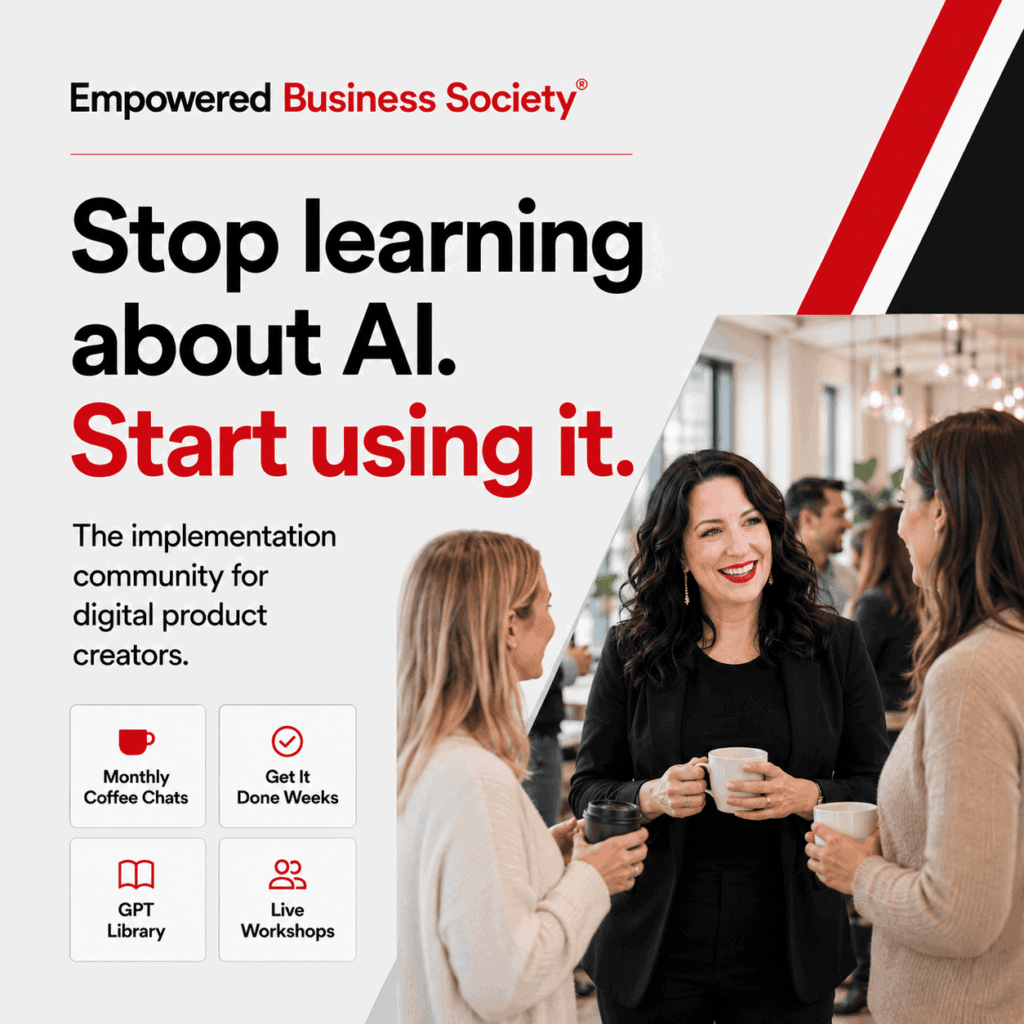

 How to extract your ChatGPT memory and custom GPT instructions so nothing gets left behind
 AI Page Lab is HERE!